Anonymous letter numbered 870
Good Morning, Midnight (Reginald Hill Edition)The Anonymous letter numbered 870 is a terse, unsigned-seeming communication to the Maciver murder inquiry whose only recorded message is a number. Its importance lies less in what it explains than in what it reopens: for Peter Pascoe, the number connects the inquiry to a poem in evidence associated with Palinurus Maciver Senior’s suicide, yet supplies no interpretation that settles the case.
Delivery and physical form
The envelope bore a local postmark dated the day before it came to attention. Its address, written in crude block capitals, directed it to the Maciver murder inquiry, Police CID, Mid-Yorkshire. The formal destination placed the communication within a specific investigation, while the postmark established only that it had been sent locally and recently; the sender’s identity remained unknown.
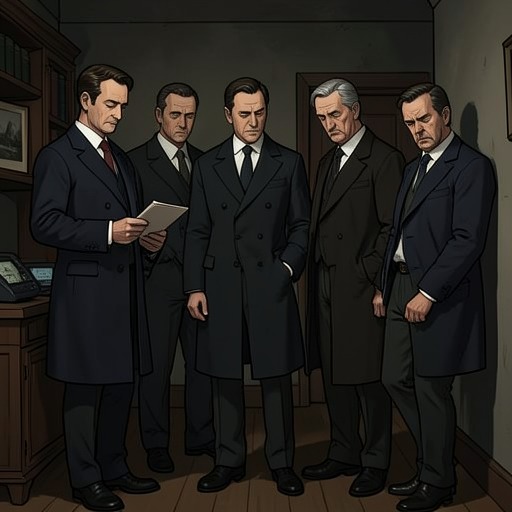
Paddy Ireland had opened the envelope. He showed Peter Pascoe a clear plastic evidence bag containing an A4 sheet, on which the number 870 was printed in the same hand as the address. No explanatory message accompanied the numeral in the account of the discovery. The contrast is striking: the envelope names an official inquiry in full, but the paper offers a sign whose meaning is initially unavailable. Pascoe joked about possible meanings, including whether it might be a date or hymn number, but neither he nor Ireland could identify it at the time.
The exchange also marks a difference in how the two officers frame the communication. Pascoe initially objects that the matter concerns the Maciver family, which he regards as Ireland’s business; Ireland insists that the word murder makes it CID business. Ireland’s decision to open the envelope shows that he has already treated it as relevant to the inquiry, even as its contents remain obscure.
The number’s delayed recognition
The clue’s significance emerges later, not at the moment the envelope is opened. Pascoe tries to dismiss both the letter and his revived doubts, telling himself that the number means nothing and that the sender is merely a malicious troublemaker. Yet 870 returns to his attention. In a free-association attempt, it becomes paired in his mind with 1062, another number connected with the case.
That mental link directs Pascoe back to the material he has kept from Palinurus Maciver Senior’s suicide. He retrieves the volume of poetry, which is still open at the blood-spattered page containing poem 1062, and turns back through it to poem 870. The letter’s number has therefore led him to a second numbered poem in the same book. This association is concrete, but it does not establish who sent the letter or why that poem was selected.
Poem 870 and its unresolved meaning
Pascoe reads poem 870 three times and remains no closer to understanding either the poet’s meaning or the sender’s. Among the poem’s phrases is Jason–sham–too, a fragment he records but cannot fit into a clear explanation. The text supplies a connection between the anonymous numeral and the numbered poem; it does not supply a key that conclusively deciphers the poem or identifies its intended recipient.
The distinction between finding a reference and interpreting it is central to the object’s role. The number is not meaningless to the investigation once it matches a poem in the volume, but the match does not make the letter’s purpose transparent. The sender’s choice of 870 may direct attention, yet the available evidence leaves the direction’s intended destination uncertain. Pascoe’s bafflement is retained rather than replaced with a definitive solution.
Effect on the investigation
Although the letter yields no answer, Pascoe treats it as an additional reason to pursue his doubts. He regards it as another feather of doubt on the scales and decides that another set of initials should be added to the file. He carefully copies out the poem and carries the sheet to Andy Dalziel’s room. The communication thus changes what Pascoe does: it prompts him to preserve the poem as a lead and take the matter to his superior.
Its effect is deliberately limited. The letter does not prove a theory about the death, explain the relationship between poems 870 and 1062, or reveal anything certain about its author. Instead, a bare number redirects Pascoe from dismissal toward renewed scrutiny. The object functions as a small but persistent disturbance in the inquiry: it supplies a verifiable textual association, increases doubt, and leaves the essential meaning open.